Coyote decoys do work, but not in every setup and not enough to fix weak stand fundamentals.
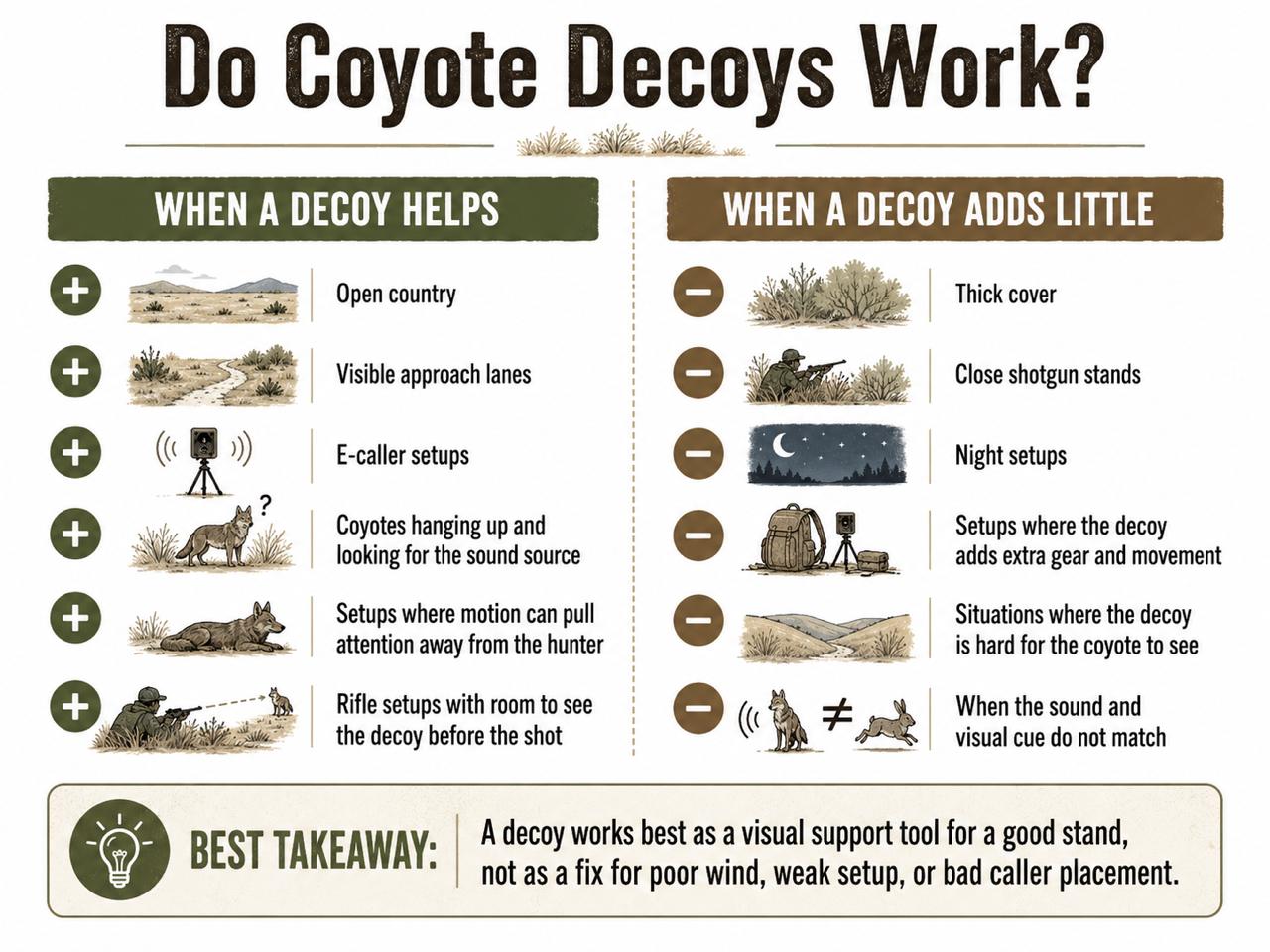
The short version is simple: a decoy helps most when it gives an incoming coyote a believable visual target that matches the sound, stays visible on the approach, and pulls attention away from the hunter. It helps a lot less in tight cover, close shotgun stands, and many night setups where the visual part of the stand matters less.
If you already have decent wind discipline, smart caller placement, and a sound sequence that fits the situation, a decoy can be a useful support tool. If those basics are still shaky, a decoy usually adds more gear and movement than actual benefit.
If your main question is which one to buy, jump to our guide to the best coyote decoys. If you are still deciding whether a decoy belongs in your setup at all, start here.
Quick Answer
Yes, coyote decoys can work, but the answer depends on terrain, visibility, time of day, and how you run the stand.
They usually help most when:
- you are calling in open country with decent visibility
- the coyote has room to spot the decoy before it reaches the sound source
- you are using an e-caller and want motion near the sound
- coyotes in your area tend to hang up and look for a visual confirmation
They are easiest to skip when:
- you hunt tight cover
- most of your shots happen fast and close
- you hunt at night and rely less on a visible focal point
- you value simple, fast, high-mobility setups over extra gear
When Coyote Decoys Help Most
A decoy usually earns its keep when it supports what the coyote already expects to see.
In practical terms, that means pairing sound with a believable visual. Distress sounds with a compact motion decoy make sense because the motion gives the animal something to lock onto. In open country, that extra visual cue can keep a coyote’s eyes off the shooter and on the caller area.
Decoys also make more sense when coyotes tend to stall, circle, or stop short while trying to locate the source of the sound. A visible motion point can help finish the picture and buy you a cleaner shot opportunity.
The strongest use cases are usually:
- open fields, pasture edges, cut ground, or rolling country with visible approach lanes
- rifle setups where coyotes may commit from farther out
- e-caller stands where sound and motion can sit together
- situations where you want attention focused away from your position
That does not make decoys magic. It just means they fit best when the stand gives them room to matter.
When a Decoy Adds Little
A decoy is much less useful when the coyote is already going to appear close, fast, or partly hidden.
In thick cover, brushy draws, timber edges, and similar tighter setups, the animal may not see the decoy until the stand is already happening at close range. At that point, the decoy is not shaping the approach much. It is just another item you carried in.
The same goes for many close shotgun stands. If a coyote is likely to pop up inside fast range, the cleanest setup is often the one with fewer moving parts.
Night hunting changes the equation too. In many night setups, the visual cue matters less than sound, wind, and stand control. A decoy is not automatically useless there, but it is usually less important than it is in visible daytime calling.
A decoy can also hurt when it adds friction:
- extra setup movement at the stand
- more gear to carry on run-and-gun days
- poor placement that leaves the decoy hidden or badly exposed
- motion or shape that does not match the sound being played
Coyote Decoy vs No Decoy: When Each Setup Makes Sense
This is the real decision most hunters are making.
A decoy setup makes sense when you want to add a visual focal point to a stand that already has enough visibility for the coyote to notice it. That usually points toward open-country daytime calling, especially with an e-caller.
A no-decoy setup makes sense when the added gear does not improve the stand enough to justify the extra complexity. That usually points toward tighter cover, quick-moving setups, night hunting, or hunters still dialing in the basics.
Here is the cleaner way to think about it:
| Setup | Usually the smarter choice when… | Main advantage | Main downside |
|---|---|---|---|
| Decoy | The coyote can see it in time and the motion supports the sound | Better visual confirmation, more focus away from the hunter | More gear, more setup, can be wasted in poor visibility |
| No decoy | The stand is tight, close, fast, or low-visibility | Simpler setup, less movement, easier mobility | Less visual confirmation near the sound source |
Neither setup is the universal winner. The right answer is the one that strengthens the specific stand in front of you.
Which Hunters Benefit Most From a Decoy?
Some hunters get more from decoys than others.
A decoy is usually a better fit for:
- open-country rifle hunters
- e-caller users who want motion near the sound source
- hunters who already understand wind, stand entry, and caller placement
- hunters dealing with coyotes that often stop and look before committing
These hunters are more likely to put the decoy where it can actually do something, instead of just carrying it because it seems useful.
Which Hunters Can Skip a Decoy?
Skipping a decoy is often the smarter choice, especially early on.
You can usually pass on one for now if:
- you are still learning basic stand setup
- you mainly hunt thick cover or fast close-range stands
- you mostly hunt at night
- you already get clean responses without a decoy
- you prefer minimalist setups with less gear and less movement
For a lot of hunters, improving stand selection and sound discipline will move the needle more than buying a decoy.
Open Country vs Tight Cover
Terrain changes the answer more than most gear discussions admit.
In open country, a decoy has space to work. Coyotes can spot motion sooner, read the caller area from farther away, and commit with a visual target in front of them. That is where decoys make the most sense.
In tight cover, the window is shorter. The coyote may only catch brief glimpses through brush or grass, and the stand may turn into a close encounter before the decoy ever matters. In that situation, simple often beats clever.
If you want to use a decoy in either terrain, placement matters just as much as product choice. Our guide on where to place a coyote decoy goes deeper on that part.
Daytime vs Night Hunting
Daylight usually gives decoys more value because the visual side of the stand is doing more work.
In daytime calling, a coyote can often see enough to connect motion with the sound. That makes a decoy more useful, especially in open ground.
At night, that visual benefit usually drops. Sound, wind, and setup discipline still matter. The decoy may matter less.
That does not mean night hunters should never use a decoy. It just means a decoy is usually lower on the priority list than a clean stand, smart sound choices, and a caller setup that matches the conditions.
If you are still sorting out sound choice, our breakdown of distress vs challenge call for coyotes is a better next step than rushing into gear.
The Biggest Mistakes Hunters Make With Decoys
Most decoy disappointment comes from using the tool in the wrong role.
Common mistakes include:
- expecting the decoy to rescue a bad stand
- placing it where an approaching coyote cannot see it soon enough
- using a visual that does not fit the sound sequence
- adding too much setup movement before the stand settles
- carrying a decoy into every stand whether the terrain supports it or not
A decoy should support the stand, not become the stand.
Final Takeaway
Coyote decoys work best when they strengthen a good calling setup. They are most useful as a visual cue that supports the sound and pulls attention away from the hunter.
They are less useful when cover is tight, shots are close, or the extra gear just makes the stand slower and messier.
If you want help choosing one, start with our shortlist of the best coyote decoys. If your bigger question is still overall caller setup, head back to the BestCoyoteCalls.com homepage, our guide on how to choose an electronic coyote caller, or our breakdown of coyote calling sequence.