If you want the short version, put the decoy near the e-caller in most setups, keep the whole setup inside your real shooting range, and adjust the distance based on cover, visibility, and the weapon you’re using.
That usually means the decoy ends up roughly 25 to 60 yards from the shooter, not because that number is magic, but because it often keeps the visual cue and sound source working together while still giving you a practical shot. In tighter cover, that setup often needs to be closer. In open country, you may have room to stretch it a bit.
The main goal is simple: give the coyote a believable focal point, then protect the likely shot, especially if the animal tries to swing downwind.
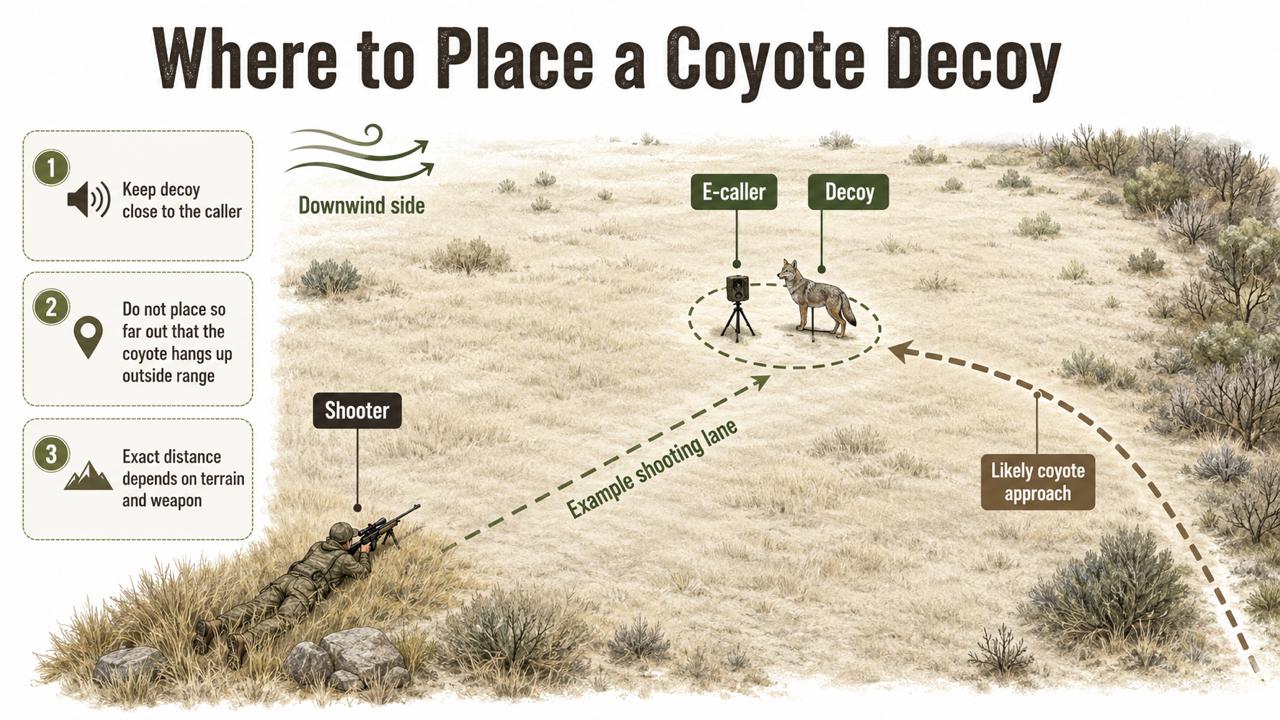
Quick Answer
In most coyote setups, the decoy should sit close to the e-caller, not way off by itself. That helps the approaching coyote connect what it sees with what it hears.
A good working range is often about 25 to 60 yards from the shooter, but that is a flexible range, not a rule you force onto every stand. Thick cover usually pushes the decoy closer. Big open country may let you place it farther out if you can still shoot confidently and cover the downwind side.
If you are still deciding whether a decoy is worth using at all, read do coyote decoys work. If you need gear picks, keep that on the product side with best coyote decoys.
The Basic Placement Rule
A decoy works better when the setup makes visual sense.
If the sound is coming from one place and the decoy is sitting far away from it, the whole scene can feel wrong. That is why the decoy usually belongs near the caller. You are trying to create one believable focal point the coyote can key on as it comes in.
This does not mean the decoy has to be touching the caller, but it usually should be close enough that the animal reads both as part of the same event.
This is also why decoy placement is not just about distance. It is about where the coyote is likely to first see the motion, how quickly it can close the gap, and whether you can get the shot before it drifts into your weak angle.
Typical Placement Range
For many stands, a practical decoy range is around 25 to 60 yards from the shooter.
That range works because it often keeps the decoy far enough out to pull attention away from the hunter, while still keeping the setup inside a realistic rifle or shotgun envelope depending on the stand.
But it is only a working range.
It is not a fixed yardage law, and it should change with:
- how much cover is between you and the expected approach
- how quickly a coyote could appear in front of the setup
- whether you are calling with a rifle or setting up for a tighter shotgun encounter
- how much room the coyote has to swing downwind before offering a shot
In other words, do not pace off one exact number and assume you are done.
Shooter, Caller, and Decoy Relationship
The easiest way to think about placement is to build the setup backward from the shot opportunity.
Start with where you can sit with decent concealment and a usable view. Then place the caller and decoy where an approaching coyote can notice them before it gets into your problem area.
In most setups:
- the shooter sits where cover, visibility, and wind let the stand function
- the caller goes out in front, inside comfortable shooting range
- the decoy stays near the caller so the sound and motion match
- the expected approach lane stays visible enough for a shot
- the likely downwind move gets attention before the coyote reaches a busted angle
That last point matters as much as straight-line distance. A setup can look perfect on paper and still fall apart if the coyote can swing downwind without giving you a clean chance.
Open Country Placement
Open country usually gives you more room to work.
Because visibility is better, you can often place the caller and decoy farther from the shooter than you would in brushy country, as long as the setup still stays inside your real shooting range. The extra space can help pull attention away from your position and make the coyote commit to the focal point out front.
The tradeoff is that open country also gives the coyote more room to stall, circle, or drift downwind. So even when you stretch the setup a bit, you still need to think hard about where that animal is most likely to try the wind.
If the downwind side is wide open and unprotected, a farther decoy does not automatically help you.
Tight Cover Placement
Tight cover usually calls for a tighter setup.
When brush, broken terrain, or limited visibility can hide an approaching coyote until the last second, pushing the decoy too far out often does more harm than good. The animal may appear suddenly, close fast, and hit the edge of the setup before you are ready.
In that kind of stand, keep the caller and decoy in closer where you can still see them clearly and shoot the likely approach lane without delay.
This is one of the easiest places to overdo decoy distance. If the country is tight, keep the whole picture compact.
Rifle Setups vs Close Shotgun Stands
Weapon choice changes how much placement room you really have.
With a rifle, you may have more tolerance to put the caller and decoy farther out, especially in open country where you can see the stand develop. That can buy a little more separation between you and the focal point.
With a close shotgun setup, the decoy usually needs to stay tighter. You are planning for a faster, shorter-range encounter, so there is less reason to push the visual too far away from the action you can actually cover.
That does not change the basic rule. In both cases, the decoy usually belongs near the caller. The difference is how far the whole package should sit from the shooter.
Common Placement Mistakes
Putting the decoy too far from the caller
This is the big one. If the decoy is separated too much from the sound source, the setup stops looking natural.
Placing it outside comfortable shooting range
A decoy does not help much if it pulls the coyote to a spot you cannot cover well.
Setting it where the coyote will not see it soon enough
If the decoy is hidden by brush, terrain, or a bad angle, it loses a lot of its value as a visual focal point.
Ignoring the downwind side
A lot of stands break down when the hunter thinks only about distance and not about where the coyote will try to get the wind.
Using the same spacing everywhere
Open flats, rolling ground, and tight cover do not call for identical placement. Let the terrain decide how tight or loose the setup should be.
Final Takeaway
Most of the time, the best place for a coyote decoy is near the e-caller, out in front of the shooter, inside realistic shooting range, and positioned so the approaching coyote can see it before slipping into the downwind escape route.
Think in terms of a believable focal point, not a magic number. Around 25 to 60 yards from the shooter is often a useful working range, but tighter cover usually means bringing it in, and open country may let you stretch it out if the shot and downwind side still make sense.
If you want to tighten the full stand plan around this setup, see coyote calling sequence, how long should a coyote calling stand last, and how long to wait between coyote calls.