If you are unsure which sound category to use, start with prey distress.
That is the safest short answer.
Prey distress is broader and easier to manage. Nonaggressive howls can be useful when you want a social or locator-style response. Pup distress and coyote distress are stronger canine-based escalation sounds. Challenge howls and aggressive barking or fight sounds are narrower, more situational tools that require more judgment and are easier to misuse.
This page is about choosing the right sound type. If you want the best opening sound by scenario, use best coyote sounds to play first. If you want the full stand structure, use the main coyote calling sequence guide.
Quick answer: distress is broader, challenge calls are more situational
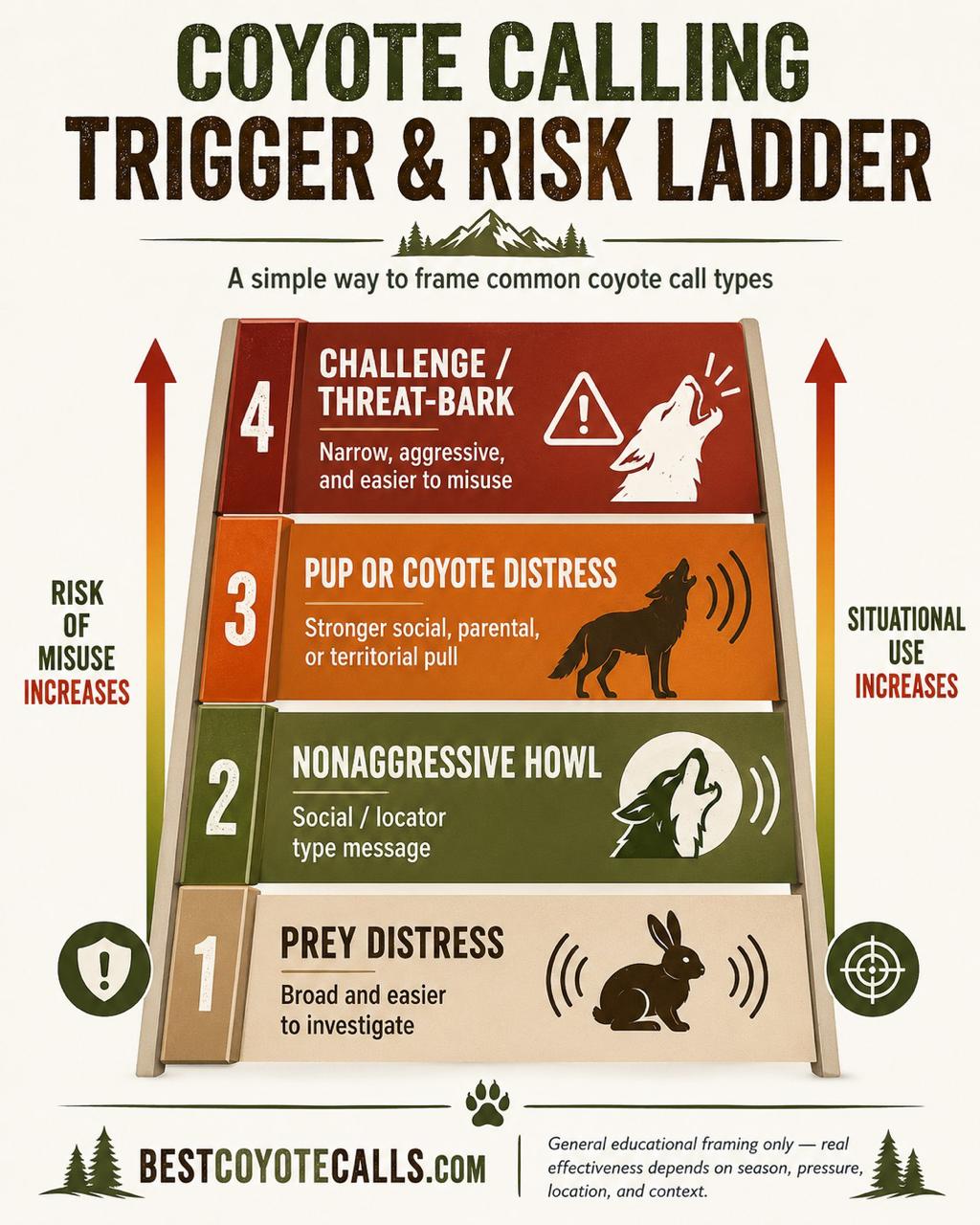
A simple framework looks like this:
| Sound type | What it usually tries to trigger | Beginner fit | Risk level |
|---|---|---|---|
| Prey distress | Food or curiosity | Best default | Low |
| Nonaggressive howl | Social or locator response | Usable with patience | Low to moderate |
| Pup distress | Stronger canine/social response | Better later in stand | Moderate |
| Coyote distress | Social conflict or stronger canine trigger | Better later in stand | Moderate to high |
| Challenge howl | Territorial or aggressive response | Not a default opener | High |
| Warning bark or aggressive bark-howl | Suspicion, alarm, or territorial tension | Not a beginner tool | Highest |
The farther down that table you go, the more judgment the sound usually requires.
What is a distress call?
A distress call usually imitates vulnerable prey.
Common examples include:
- rabbit distress
- cottontail distress
- rodent distress
- bird distress
- fawn distress
These sounds mainly create a food or curiosity trigger. That is why they are the safer beginner default.
Why distress sounds work well as a starting point:
- they are simple to understand
- they fit a wide range of setups
- they are less socially complicated than coyote vocals
- they leave room to escalate later if needed
That does not mean every distress sound works equally well everywhere. Common rabbit sounds can be overused in pressured areas, and louder distress can be too much in close cover. But if the question is which category is safest to start with, prey distress still wins most of the time.
What is a challenge call?
A challenge call, usually a challenge howl or challenge bark-howl, is more territorial and aggressive.
It is trying to provoke or answer a social conflict, not just suggest an easy meal.
That is why it is more situational.
Challenge calls can make sense when:
- coyotes are known to be nearby
- a coyote has already answered aggressively
- the setup supports a territorial response
- the stand is later in the sequence
- the caller knows why a harder vocal fits the moment
Challenge calls are not the same as a lone howl, locator howl, or other nonaggressive social howls.
That distinction matters because many beginners hear “howl” and treat every howl like the same tool. It is not.
Distress vs challenge calls: practical comparison
| Sound type | Likely trigger | Best use | Main risk | Where it often fits |
|---|---|---|---|---|
| Rabbit or cottontail distress | Food, curiosity | Beginner opener, general calling | Common and sometimes overused | Opening sound |
| Rodent or soft prey distress | Food, curiosity | Quiet start, close cover, pressured setups | Less reach | Opening sound |
| Nonaggressive howl | Social, locator | Social opener, breeding or curiosity context | Can draw vocals without movement | Opening alternative |
| Pup distress | Social, parental, territorial, curiosity | Stronger mid-stand escalation | Easy to overuse | Middle or later |
| Coyote distress | Social conflict, canine distress | Later escalation, answered-but-hung-up situations | More intense and narrower | Middle or later |
| Challenge howl | Territorial aggression | Selective advanced use | Can intimidate or mismatch the stand | Selective escalation |
The practical takeaway is simple: prey distress is the broader tool, while challenge calls are a narrower one.
Nonaggressive howls are not the same as challenge howls
This is one of the most important distinctions on the page.
A nonaggressive howl can work as:
- a social opener
- a locator-style sound
- a way to announce another coyote is present
- a seasonal shift away from food-only calling
A challenge howl is more confrontational.
A cleaner way to think about it is this:
- lone or locator howl = social presence
- challenge howl = territorial pressure
That is why a lone howl can be a valid opener while a challenge howl is usually not the safest opener for beginners.
If you use a howl, timing matters. You usually want more patience after a howl than after a prey-distress burst. For that part of the decision, use how long to wait between coyote calls.
Where pup distress fits
Pup distress sits in the middle of the ladder.
It is not basic prey distress, and it is not the same as a hard challenge howl.
Pup distress can trigger:
- social interest
- parental response
- territorial response
- curiosity about another coyote in trouble
That is why it often fits best as a mid-stand or late-stand escalation.
It can be a strong way to change the stand's trigger after prey distress had time to work. It can also help when coyotes answered but did not commit.
What it usually is not:
- the best default beginner opener
- a magic panic button
- a sound that means the same thing in every season or setup
Where coyote distress fits
Coyote distress is another stronger canine-based trigger.
It usually suggests social conflict, stress, harassment, or another coyote in trouble. In practical calling terms, it often works as a step up from simple prey distress.
A good use for coyote distress is when:
- the stand needs a stronger social or conflict trigger
- prey distress already had a fair chance
- coyotes answered but would not close
- you want a more canine-centered sound without jumping straight into a hard challenge sound
Like pup distress, this is usually a later-sequence tool, not a default first move.
When to use prey distress
Prey distress usually makes the most sense when:
- you are a beginner
- you are opening the stand
- you want the broadest, lowest-risk trigger
- the setup does not give you a strong reason to go aggressive
- you want a cleaner, simpler sequence
That is why the first-sound page still routes most users toward prey-first thinking.
If you are deciding what to open with, go to best coyote sounds to play first.
When to use a nonaggressive howl
A nonaggressive howl can make sense when:
- you want a social opener instead of a food opener
- you heard coyotes nearby
- the season or mood of the area feels more social
- prey distress feels too obvious for the setup
- you are willing to wait after the sound
The big caution is patience.
A howl often creates a different kind of response than prey distress. It may draw vocal answers first. It may also bring in a coyote quietly. That is one reason howl timing deserves its own interval page.
When challenge howls may make sense
Challenge howls may make sense when:
- coyotes responded aggressively
- you have a clear territorial context
- the stand is later and needs a sharper trigger
- known coyotes are nearby
- you understand the difference between social and aggressive vocals
Even then, challenge howls are not mandatory.
They are a selective tool, not the answer to every quiet stand.
When aggressive vocals are a bad idea
Aggressive vocals are a bad default when:
- you are a beginner
- the setup is weak
- coyotes may already be suspicious
- you are using them out of frustration
- you cannot tell the difference between a lone howl and a challenge howl
- there is no reason to challenge anything in the stand
A lot of calling advice gets worse when challenge sounds are framed as a shortcut. They are not a shortcut. They are a narrower move that only makes sense when the stand gives you a reason.
What about warning barks or threat-bark sounds?
This is where fake certainty causes trouble.
Repeated barking or bark-howl type sounds can point to:
- suspicion
- alarm
- territorial tension
- a coyote detecting something wrong
- a stand that may already be compromised
The exact meaning is not always obvious.
That is why a warning bark should usually be treated as a caution sign, not an invitation. If you are still learning the basic ladder, the safer move is to stay higher up the opener stack covered in best coyote sounds to play first.
A practical beginner-safe rule is this:
If a coyote is barking repeatedly after your setup, assume something may be wrong before you assume you have a clean challenge opportunity.
That does not mean every bark means the stand is dead. It means barking is not simple enough to teach like a default beginner play.
Sound-type risk ladder
A simple risk ladder helps keep this topic clear.
- Rabbit or cottontail distress
- Rodent or soft prey distress
- Nonaggressive lone or locator howl
- Pup distress
- Coyote distress or fight-type sounds
- Challenge howl
- Threat bark, warning bark, or aggressive barking
The farther down the ladder you go, the more judgment the sound usually requires.
That is why beginners should spend most of their time at the top of the ladder, not the bottom. If you want the stripped-down version of that approach, use coyote calling sequence for beginners.
Use this first, save this for later
| Use first | Save for later |
|---|---|
| Rabbit distress | Pup distress |
| Cottontail distress | Coyote distress |
| Rodent distress | Challenge howl |
| Soft prey distress | Fight sounds |
| Optional nonaggressive lone howl | Warning bark or aggressive bark-howl sounds |
That table is not saying the right column never works. It is saying those sounds require more reason and more judgment.
How these sounds fit into a calling sequence
A clean sequence often moves from broader triggers to narrower ones.
That can look like:
- prey distress to open
- silence or repetition to let it work
- a second prey sound or volume change if needed
- pup distress or coyote distress later
- challenge howl only when the stand supports it
That is the sequence-level view.
If you want the full step-by-step structure, use the main coyote calling sequence guide. If you want the timing of the switch itself, use how long to wait between coyote calls.
Caller sound libraries: what to look for
This is not a buyer guide, but the caller's sound library does matter here.
Useful features include:
- a solid group of prey distress sounds
- softer prey options, not just loud rabbit sounds
- pup distress and coyote distress categories
- basic nonaggressive coyote vocals
- clear sound organization
- quick sound changes without extra movement
More sounds are not automatically better. A smaller well-organized library can be more useful than a huge messy one.
If you want callers with both distress and coyote vocal sounds, the best coyote calls homepage and how to choose an electronic coyote caller are the natural next steps.
Final takeaway
If you are unsure, start with prey distress.
Use nonaggressive howls when you want a social response. Use pup distress or coyote distress when the stand needs a stronger canine-based trigger. Save challenge howls and aggressive bark-type sounds for situations where the stand gives you a real reason.
The simple rule is this:
- use distress when you want the broadest, safest trigger
- use vocals when you know what response you are trying to create
- use aggressive sounds only when the stand gives you a reason