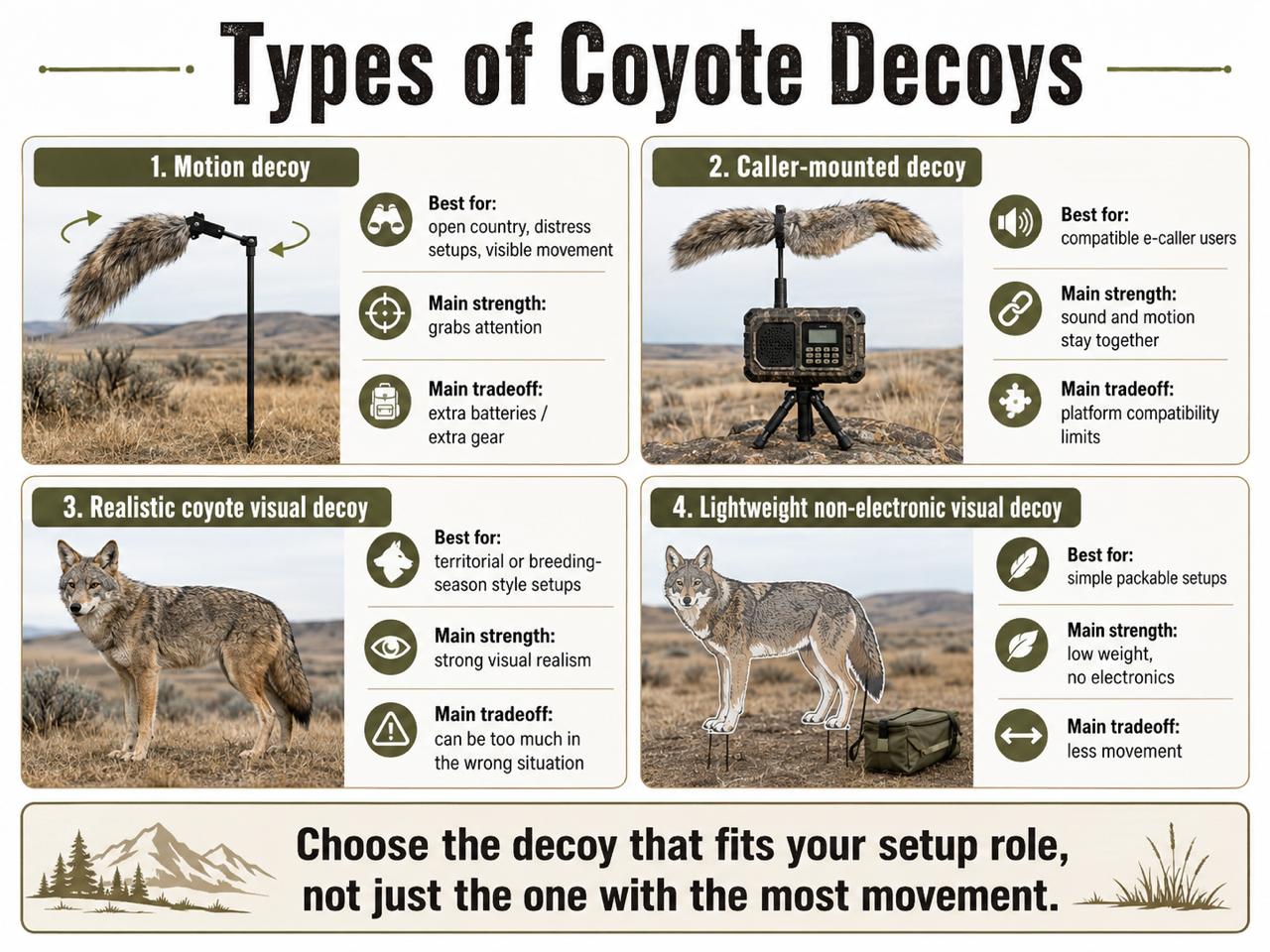
The best coyote decoy depends on what job you want it to do.
Some hunters want a compact motion decoy that gives distress sounds a believable visual. Some want a realistic coyote silhouette for more territorial situations. Others want a decoy that fits an existing FOXPRO or iCOTEC setup without turning a simple stand into a gear project.
The key is to buy for role, not for hype. A flashy decoy is not automatically the best choice if your terrain, calling style, or caller platform points toward something simpler.
If you are still unsure whether you even need one, read Do Coyote Decoys Work? first. If you already know a decoy fits your setup, this shortlist is the cleaner place to start.
Quick Answer
For most buyers, the best coyote decoys break down like this:
- Best simple motion decoy for beginners: Lucky Duck Lil’ Critter
- Best stronger standalone motion decoy for e-caller setups: Lucky Duck King Critter
- Best FOXPRO-compatible option: FOXPRO XDECOY for broader compatibility, or FoxJack 5 if you specifically want an attachable FOXPRO add-on
- Best iCOTEC-friendly option: iCOTEC PD200 if you want standalone flexibility, or AD400 if you want an attachable option
- Best realistic coyote visual decoy: Lucky Duck Yote Coyote
- Best lightweight non-electronic visual: Montana Decoy Miss Hoptober
The right pick depends on whether you want motion, realism, packability, or platform compatibility.
Do You Even Need a Decoy?
Not always.
A decoy is most useful when it adds a visible focal point to a stand that already has decent visibility and a caller setup that benefits from motion near the sound. It is less important in tight cover, fast close-range setups, and many night stands.
If that decision still feels unsettled, go to Do Coyote Decoys Work? before spending money.
What to Look for in a Coyote Decoy
The best coyote decoys for calling setups usually come down to five things.
Motion type
Small prey-style motion decoys fit distress-heavy setups best. They are often the easiest way to add believable action near an e-caller.
Realism
A realistic coyote visual can make sense in territorial contexts, but it is more niche than a simple motion decoy. It also needs the right situation to make sense.
Packability
If a decoy is annoying to carry, slow to deploy, or awkward in rough terrain, it gets left behind. Simpler often wins.
Platform compatibility
Some of the best options are universal. Others are better when you already run a specific FOXPRO or iCOTEC setup. That is not a problem, but it should be clear before you buy.
Simplicity
A decoy should make the stand cleaner, not busier. If it adds too much setup friction, it is probably the wrong decoy for your style.
Best Coyote Decoys
Here is the shortlist, grouped by actual use case instead of padded rank slots.
Lucky Duck Lil’ Critter
Best motion decoy for beginners
If you want the easiest entry into decoy use, this is the cleanest starting point. A small motion decoy fits the most common coyote-calling use case: adding visible movement near distress sounds without overcomplicating the stand.
Why it stands out:
- simple role and easy use-case fit
- beginner-friendly for daytime calling
- easier to justify than a bulky or highly niche decoy
Best for:
- new decoy users
- hunters who want a small motion cue near the caller
- buyers who value simplicity over platform-specific attachments
Lucky Duck King Critter
Best standalone motion decoy for e-caller setups
This is a stronger fit for hunters who know they want a more purpose-built standalone motion decoy around their caller area. It still serves the same basic role as smaller motion models, but with a more committed setup angle.
Why it stands out:
- strong fit for e-caller-centered stands
- built for hunters who already know motion decoys work in their terrain
- good step up from the most basic decoy category
Best for:
- open-country callers
- rifle hunters who want visible motion near the sound source
- hunters who already run an e-caller regularly
FOXPRO XDECOY
Best FOXPRO-compatible pick for buyers who want flexibility
For FOXPRO users, the XDECOY makes the most sense when you want a decoy choice that stays centered on decoy usefulness, not just brand loyalty. It is the cleaner recommendation when flexibility matters more than using an attachable topper.
Why it stands out:
- natural fit for FOXPRO-oriented buyers
- easier recommendation than older compatibility-dependent options
- useful for shoppers who want a decoy lane without turning the page into a caller review
Best for:
- FOXPRO users shopping within the ecosystem
- buyers who want a cleaner current-model recommendation
- hunters who want motion support without overthinking the setup
FOXPRO FoxJack 5
Best attachable FOXPRO decoy for compatible setups
The FoxJack 5 makes sense if you specifically want an attachable decoy that works with a compatible FOXPRO setup. That can be a clean solution, but only if you are sure your caller platform is the right match.
Why it stands out:
- tidy add-on concept for compatible FOXPRO users
- good fit for buyers who want motion attached to the caller system
- useful when you want fewer separate pieces in the field
Best for:
- existing FOXPRO users with compatible units
- buyers who prefer an attachable decoy format
Compatibility note:
- check compatibility before buying, because attachable FOXPRO decoys are not universal across every caller
iCOTEC PD200 Universal Predator Decoy
Best iCOTEC-friendly standalone option
The PD200 is the better recommendation when you want iCOTEC relevance without locking yourself into an attachable-only format. That makes it the cleaner choice for buyers who want standalone flexibility.
Why it stands out:
- more flexible than a platform-only attachment route
- good fit for buyers who want a motion decoy without overcommitting to one setup style
- easier to recommend broadly than narrower add-ons
Best for:
- iCOTEC users
- buyers who may change caller setups later
- hunters who want standalone decoy portability
iCOTEC AD400 Attachable Predator Decoy
Best attachable iCOTEC option
If you already know you want an attachable iCOTEC-style decoy, the AD400 is the more specific route. It is not the best fit for every buyer, but it does make sense for platform-loyal users who want a tighter integrated setup.
Why it stands out:
- direct fit for buyers who want an attachable iCOTEC option
- better as a use-case-specific recommendation than a universal one
Best for:
- committed iCOTEC users
- buyers who prefer an attachable form factor over a separate standalone decoy
Compatibility note:
- treat this as a platform-specific buy, not a universal recommendation
Lucky Duck Yote Coyote
Best realistic coyote visual decoy
This is the shortlist pick when you specifically want a realistic coyote visual rather than a prey-style motion decoy. That is a narrower job, but it is still a real one.
Why it stands out:
- clearest fit for hunters who want a true coyote visual
- more purpose-specific than generic predator silhouettes
- distinct enough from motion decoys to justify its own lane
Best for:
- territorial or visual-context setups
- hunters who understand that realistic coyote visuals are more situational than universal
Montana Decoy Song Dog Coyote Decoy
Strong lightweight alternative for coyote-visual use
If you want a coyote-shaped visual but prefer a lighter decoy style, the Song Dog is the other clean shortlist option. It is a reasonable alternative when portability matters more than a more elaborate visual setup.
Best for:
- hunters who want a coyote visual with lighter carry weight
- buyers comparing coyote-shape options rather than prey-motion decoys
Montana Decoy Miss Hoptober
Best lightweight non-electronic decoy
This is the pick for hunters who want a simple visual decoy without batteries, platform tie-ins, or much setup fuss. It is not the same thing as a motion decoy, but that is exactly why it deserves a place on the shortlist.
Why it stands out:
- very simple role
- lightweight and easy to pack
- useful for hunters who want a visual cue without electronic complexity
Best for:
- minimalist setups
- hunters who care more about low bulk than added motion
- buyers who do not want another electronic device in the field
Shortlist by Buyer Type
| Buyer type | Best fit |
|---|---|
| Beginner who wants a simple motion decoy | Lucky Duck Lil’ Critter |
| Open-country hunter running an e-caller | Lucky Duck King Critter |
| FOXPRO user wanting a flexible current pick | FOXPRO XDECOY |
| FOXPRO user wanting an attachable decoy | FoxJack 5 |
| iCOTEC user wanting standalone flexibility | iCOTEC PD200 |
| iCOTEC user wanting an attachable option | iCOTEC AD400 |
| Hunter wanting a realistic coyote visual | Lucky Duck Yote Coyote |
| Hunter wanting a lightweight coyote visual alternative | Montana Song Dog Coyote Decoy |
| Hunter wanting a lightweight non-electronic visual | Montana Miss Hoptober |
Compatibility Warnings to Keep in Mind
A few decoy types need more caution than others.
- Attachable FOXPRO and iCOTEC models are not universal. Check fit before buying.
- Older or narrower platform-specific decoys can be useful, but they are not good default recommendations.
- Realistic coyote visuals are more situational than motion decoys and should not be treated as the automatic first buy.
- Combo-style thinking can pull you into broader caller comparisons. Keep the decision centered on whether the decoy improves your actual stand.
That is also why FoxJack 3 is not a core recommendation here. It can still matter for some shoppers, but it needs stronger compatibility caution than cleaner current picks.
When a Decoy Is Not Worth Buying Yet
You probably do not need to buy a decoy yet if:
- you are still learning basic stand setup
- you mostly hunt thick cover
- you hunt at night more than in visible daytime conditions
- your current no-decoy stands already produce clean responses
- your bigger need is a better caller decision, not an accessory decision
If that sounds like you, put the money and attention into caller choice, setup discipline, and sound selection first. The BestCoyoteCalls.com homepage and our guide on how to choose an electronic coyote caller are better starting points.
Final Takeaway
The best coyote decoy is the one that fits your calling style, terrain, and tolerance for setup complexity.
For most buyers, a simple motion decoy is the easiest place to start. Platform-specific attachable models make sense when you already know your caller setup and compatibility. Realistic coyote visuals are useful, but they are more situational than many shoppers expect.
If you still need help deciding whether a decoy belongs in your setup at all, read Do Coyote Decoys Work?. Once you choose a model, the next smart step is where to place a coyote decoy. If you are still sorting out caller platforms, see FOXPRO vs iCOTEC coyote calls or our guide to FOXPRO Prowler vs Hellcat.