This page may contain affiliate links. If you buy through them, the site may earn a commission at no extra cost to you.

This topic gets messy because hunters often use “distress” like it means one thing.
It does not.
Prey distress, pup distress, coyote distress, lone howls, interrogation howls, and challenge-style vocals are not interchangeable. They can all work, but they do not ask the coyote to respond for the same reason.
That is why this page should start with clarity, not hype.
Table of Contents
Quick answer
If you want the broader, safer play, prey distress usually casts the wider net.
If you want the narrower, more confrontational play, challenge-style vocals can make sense in the right context, but they are easier to misuse and more likely to backfire when the setup does not support them.
Define the terms first
Prey distress
Food signal. Broadest appeal. Lowest intimidation.
Pup distress or coyote distress
Not the same as prey distress. These sounds can pull social, parental, territorial, or investigative responses depending on context.
Lone or nonaggressive howl
This is different from a challenge sound. It can announce another coyote without turning the stand into an immediate confrontation.
Challenge howl / threat-bark style sound
This is the sound category most likely to get oversold. A hard territorial message can work in narrow situations, but it is not a casual replacement for lower-pressure sounds.
The trigger and risk ladder
A simple way to frame it:
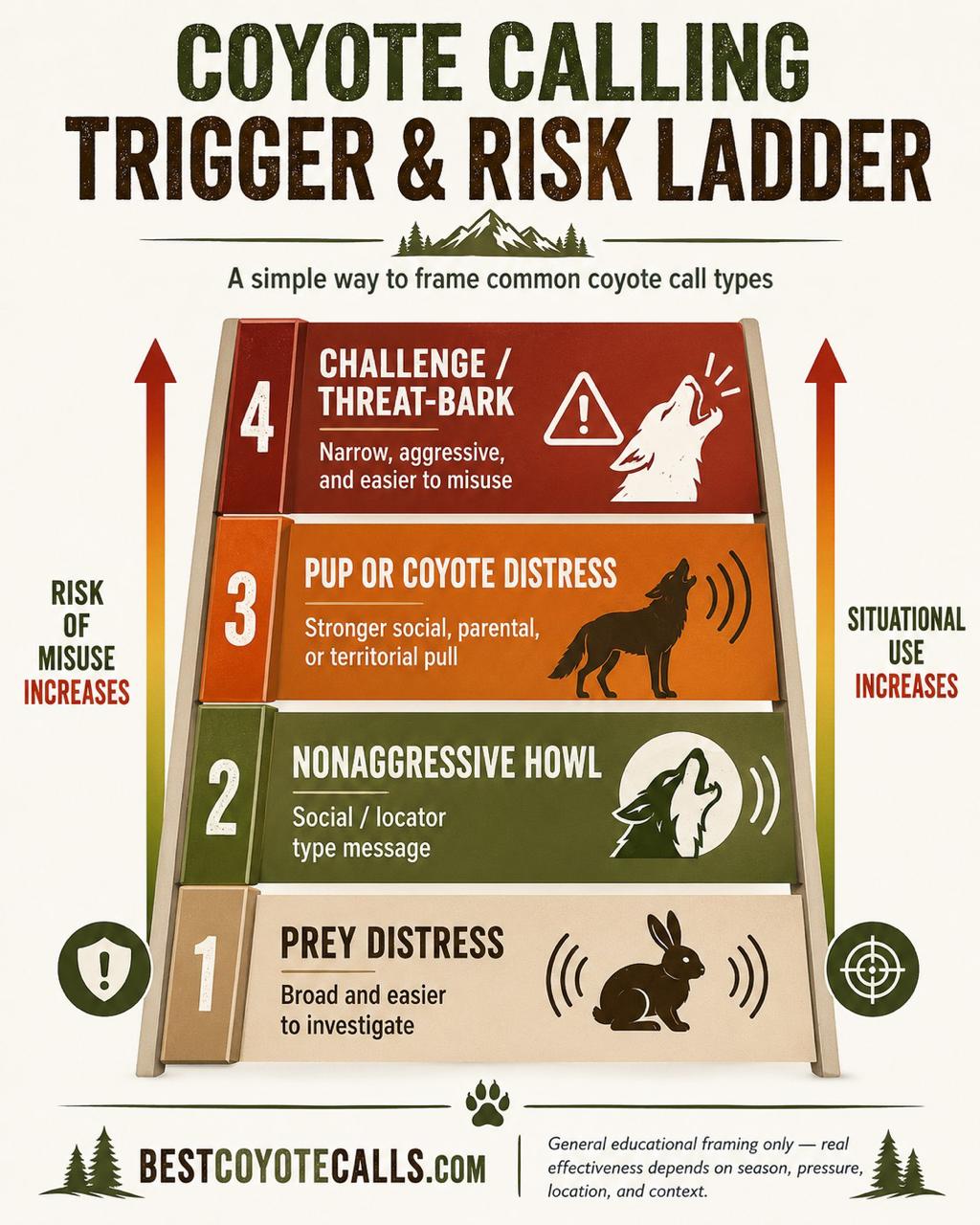
- prey distress: broad and easier to investigate
- nonaggressive howl: social / locator type message
- pup or coyote distress: stronger social, parental, or territorial pull
- challenge / threat-bark: narrow, aggressive, and easier to misuse
That is why this is a ladder, not a coin flip.
When prey distress makes more sense
Prey distress makes more sense when:
- you want broad appeal
- you are not sure a confrontational message fits the setup
- you want the lower-risk opener or transition
- the goal is to sound like food, not conflict
That does not make it weak. It makes it easier to fit more stands cleanly.
When a challenge-style sound can fit
Challenge-style vocals make more sense when the stand actually gives you a reason to lean on territorial pressure.
That is very different from using them because they sound exciting on the remote menu.
The problem is not that challenge sounds never work. The problem is that many callers skip straight to them without first deciding whether the stand really supports that story.
When challenge howls backfire
A harder territorial sound can backfire when:
- the coyote does not want confrontation
- the stand is not in the right kind of territory context
- the sound is stronger or more aggressive than the situation justifies
- the caller escalates too quickly
That is one reason challenge-style sounds are not a good default beginner move.
What to do if coyotes howl back but do not come
Do not assume the answer is always more aggression.
Better next steps can include:
- waiting longer before changing the message
- answering less aggressively
- shifting into a lower-pressure distress sound
- leaving the stand alone and repositioning later if needed
The goal is not to win an argument. The goal is to get a coyote to commit.